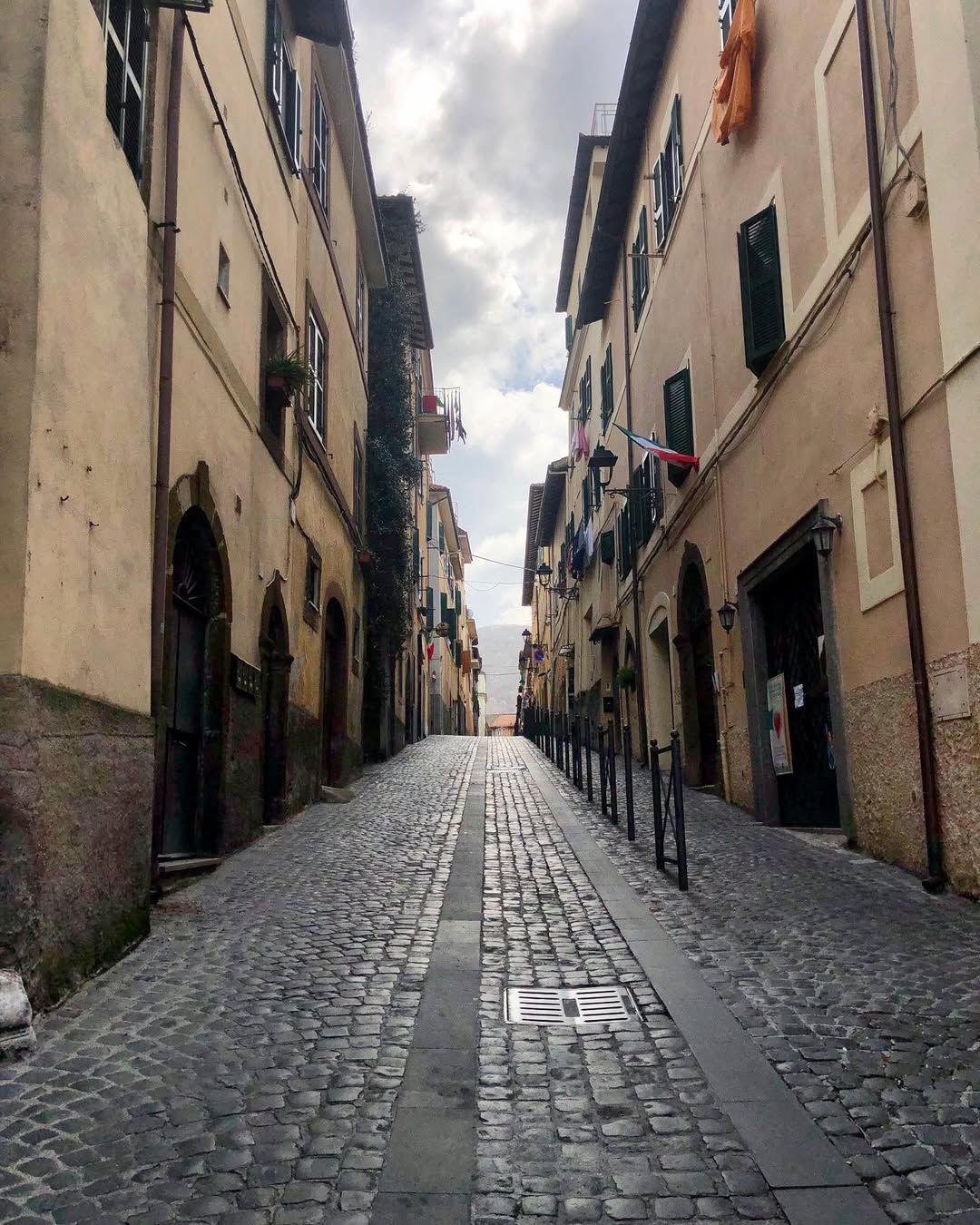
Monte Porzio Catone sits on a hill of about 450 metres looking at Rome from the south east. The town you see today, packed around its main church and the Palazzo Borghese, is a little over four hundred years old. The history of the hill starts much earlier, and runs through Roman villas, a ruined castle, popes on summer holiday and a family of princes who laid the town out street by street.
Roman times: the villas under the town
Before the town there were villas. Roman walls in opus reticulatum have been found under the main church, perhaps from a villa built right on the top of the hill. The whole area around was dotted with houses of the Roman aristocracy: the villa of Matidia, a relative of the emperor Hadrian, whose remains now lie under the Astronomical Observatory; the huge platform of the Barco Borghese; and higher up the city of Tusculum, birthplace of Cato the Censor.
Middle Ages: Monte Porculi and the castrum
After the end of the Roman world the hill stayed inhabited. Documents mention a Massa Porculis from the eighth century, “Monte Porculo” in a donation by the Counts of Tusculum in 1068, and “Monte Porculi” among the properties of the monastery of San Paolo fuori le Mura in a bull of Pope Gregory VII of 1074.
At the beginning of the twelfth century the top of the hill was a castrum, a small fortified village owned by the monastery of San Paolo. At its foot, on 29 May 1167, the battle of Monte Porzio was fought, in which the Tusculans and imperial troops defeated the army of Rome. Twenty four years later, in 1191, Rome took its revenge and destroyed Tusculum for good.
In 1400 the pope gave the castle to Teobaldo Annibaldi, as a counterweight to the Colonna family. By the second half of the fifteenth century the castrum was already in ruins, and in 1565 all that was left of the fortress was a boundary wall, a tower and a meadow.
The sixteenth century: a new beginning
The revival came with the papal villas. Cardinal Marco Sittico Altemps bought the nearby Villa Angelina, today Villa Vecchia, in 1569, and between 1573 and 1574 he built Villa Mondragone to host Pope Gregory XIII. It was the pope who started the refounding of the town: in 1579 Gregory XIII had a new parish church built, designed by Martino Longhi, and houses grew back around it. Around 1581-1582 the Altemps also bought the village.
The seventeenth and eighteenth centuries: two centuries of Borghese
In 1613 the fief passed to Cardinal Scipione Borghese, nephew of Pope Paul V, who bought up all the Altemps properties and encouraged people to settle in the town. Borghese rule lasted about two centuries, until fiefs were abolished, and the town of today is largely their work.
- The plan of the town. The centre follows a trident layout typical of Baroque town planning, on a small scale as in Genzano and Albano. A main axis links the Palazzo Borghese, the symbolic gate of the village, to the square of the main church, passing through the little market square and piazza Porzio Catone.
- The Tusculan Hermitage. Between 1607 and 1613 the Camaldolese monks built their hermitage on the hills nearby.
- The main church. In 1666 Prince Giovanni Battista Borghese, following the will of Pope Paul V, had the church of San Gregorio Magno rebuilt from scratch, dedicated to the saint who shared his name with the pope of the calendar. The design is attributed to Carlo Rainaldi. About a century later it was consecrated again by Cardinal Henry Benedict Stuart, Duke of York.
- The eighteenth century. Palaces such as the Ricci-Moscatelli, looking over the plain, were built, along with the Oratory of Sant’Antonio, of 1769.
The nineteenth century: from the popes to the Kingdom of Italy
In 1827 Pope Leo XII visited the town, as an inscription in piazza Porzio Catone recalls. In 1849 Monte Porzio had about 1,180 inhabitants. The Jesuits turned Mondragone into the Nobile Collegio Mondragone, a school for young noblemen: the sources give 1865 for its opening and 1896 for the sale to the Society of Jesus.
The unification of Italy brought the present name: by a royal decree of 30 December 1872 Monte Porzio became Monte Porzio Catone, to tell it apart from a town with the same name in the Marche. The full story is in why is it called Monte Porzio Catone. In 1883 the monument to the Garibaldino was put up in the square.
The twentieth century
- The train. The town was served by the railway; service at the local stations ended in 1944. The old railway buildings now house the Wine Museum, opened in 2024.
- The war. During the Second World War Villa Parisi sheltered people who had fled their homes, and they stayed until 1951.
- The Observatory. The building of the Rome Astronomical Observatory, designed at the end of the 1930s, was assigned to the institute in 1948 and since 1988 it has been its main research site, above the remains of the Roman villa of Matidia.
- The earthquake. In 1980 a strong tremor forced the main church to close; restoration began in 1992 and was completed in 2011.
- The university. In 1981 Villa Mondragone passed to the University of Rome Tor Vergata.
Monte Porzio Catone today
Today the town has about 8,600 inhabitants. It lies within the Castelli Romani Regional Park and the Frascati DOC wine area, and looks after a small group of museums: the Museo della Città in the rooms of the main church, the Wine Museum and the archaeological complex of the Barco Borghese. The vineyards are still the first thing you see as you arrive, as in Cato’s day.
Key dates
| Year | What happens |
|---|---|
| 1st century BC - 2nd century AD | Roman villas on the hill and around it |
| 8th century | First mention of the Massa Porculis |
| 1068 / 1074 | “Monte Porculo” and “Monte Porculi” in documents |
| 12th century | Castrum owned by the monastery of San Paolo |
| 1167 | Battle of Monte Porzio |
| 1191 | Destruction of Tusculum |
| 1400 | The castle passes to the Annibaldi |
| 1573-1574 | Villa Mondragone built for Gregory XIII |
| 1579 | New parish church: the town is refounded |
| around 1581-1582 | The village passes to the Altemps |
| 1613 | The Borghese fief begins, for about two centuries |
| 1666 | New church of San Gregorio Magno |
| 1872 | The town becomes Monte Porzio Catone |
| 1948 | The Monte Porzio building is assigned to the Rome Astronomical Observatory |
| 1981 | Villa Mondragone passes to Tor Vergata University |
Sources
- Comune di Monte Porzio Catone, walks in the old town (ProntoCastelli)
- Castelli Notizie, Cosa vedere a Monte Porzio Catone (2024)
- M. Valenti, Museo della Città di Monteporzio, Vivavoce no. 62, 2007
- Italian Ministry of Culture, Parco archeologico culturale di Tuscolo
- University of Rome Tor Vergata, Villa Mondragone
- Monte Porzio Catone (reference entry, with bibliography: Antonelli, Ilari, Monte Porzio Catone nel suo tempo, 1990)
- Italian Ministry of Culture, AstroLAB at INAF, Rome Astronomical Observatory
Written by Osteria Il Tinello, Monte Porzio Catone. Last updated: 5 November 2026. Spotted a mistake? Message us on WhatsApp.