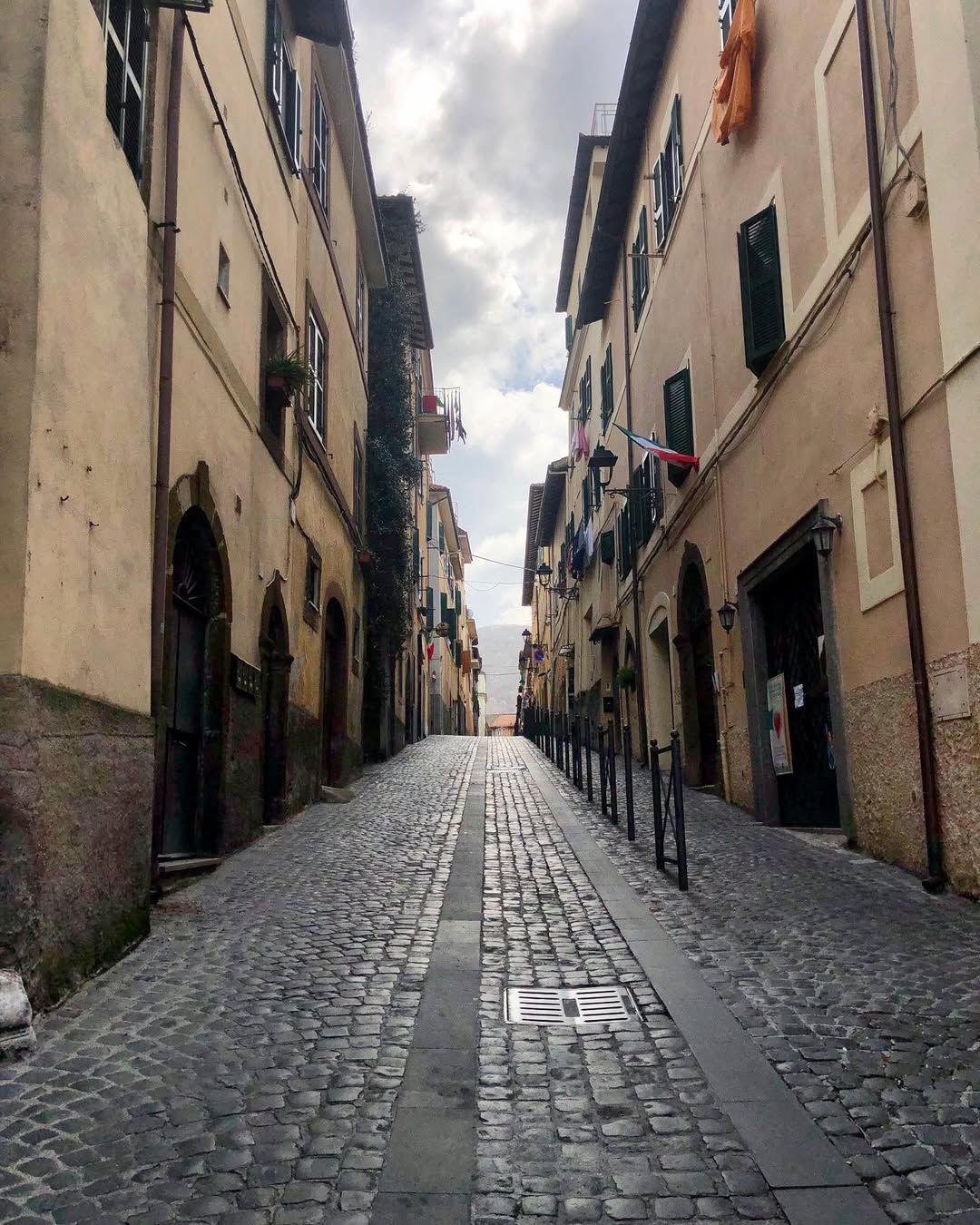
The municipality of Monte Porzio Catone borders that of Rome, and the town sits on a hill of about 450 metres looking towards the city. The relationship between the two is very old and has not always been peaceful: sometimes the Romans came here to rest, sometimes they came to destroy.
The Romans’ hill
In antiquity the hill was a land of villas. Roman walls have been found under the main church, and the whole area around was dotted with houses of Rome’s aristocracy, such as the one attributed to Matidia, a relative of the emperor Hadrian, whose remains now lie under the Astronomical Observatory. Just above, on the hill, stood the Latin city of Tusculum, where the Romans had their summer villas, among them that of Cicero.
From Tusculum also came a man who would leave a deep mark on Rome: Cato the Censor, born around 234 BC and a leading figure in Roman politics for decades. His story is in Cato the Censor, the Roman born at Tusculum, and it is from him that the town takes the second half of its name.
When Rome destroyed Tusculum
In the Middle Ages relations grew harsher. On 29 May 1167, at the foot of the hill of Monte Porzio, the Tusculans and the troops of Emperor Frederick Barbarossa defeated a Roman army in the battle of Monte Porzio. Twenty four years later, in 1191, it was Rome’s turn for revenge: the Commune decided to destroy Tusculum, which was never rebuilt.
The town, meanwhile, stayed small and in other hands. A bull of Gregory VII of 1074 lists “Monte Porculi” among the properties of the Roman monastery of San Paolo fuori le Mura. In the fifteenth century the castle passed to the Annibaldi, in 1581 to the Altemps, in 1613 to the Borghese.
Popes and cardinals
With the sixteenth century the link with Rome became that of the papal court. Cardinal Marco Sittico Altemps built Villa Mondragone to host Pope Gregory XIII, and around the villas the town’s houses returned. Under the Borghese, the family of Paul V, Monte Porzio became a village laid out by princes, with the Palazzo Borghese as its gateway and the main church at the top of the main street, as told in the walk through the old town.
In 1827 Pope Leo XII visited the town, as an inscription in piazza Porzio Catone recalls.
From papal town to Italian municipality
With the unification of Italy the name changed: by royal decree of 30 December 1872 Monte Porzio became Monte Porzio Catone, to tell it apart from the town of the same name in the Marche. In the twentieth century the relationship with Rome took new forms: in 1948 the Monte Porzio building was assigned to the Rome Astronomical Observatory, and in 1981 Villa Mondragone passed to Tor Vergata University.
Today
Monte Porzio Catone has about 8,600 inhabitants and lies about 10 kilometres from Rome’s ring road, the Grande Raccordo Anulare, leaving by the A1 motorway: for directions and public transport see how to get here from Rome. It is still a town of the Castelli Romani, with its vineyards and its festivals, starting with that of Sant’Antonino Martire, the patron saint, which falls on 2 September.
In short
- Borders: the municipality of Monte Porzio Catone borders that of Rome.
- Antiquity: Roman villas, Tusculum and the birth of Cato the Censor.
- Middle Ages: battle of Monte Porzio (1167), destruction of Tusculum by Rome (1191).
- Early modern period: villas of popes and cardinals, then the Borghese from 1613.
- Today: the Rome Astronomical Observatory since 1948 and Tor Vergata University’s Villa Mondragone since 1981.
Sources
- Wikipedia, Monte Porzio Catone
- Italian Ministry of Culture, Parco archeologico culturale di Tuscolo
- Wikipedia, Catone il Censore
- Wikipedia, Battle of Monte Porzio
- University of Rome Tor Vergata, Villa Mondragone
Written by Osteria Il Tinello, Monte Porzio Catone. Last updated: 5 November 2026. Spotted a mistake? Message us on WhatsApp.