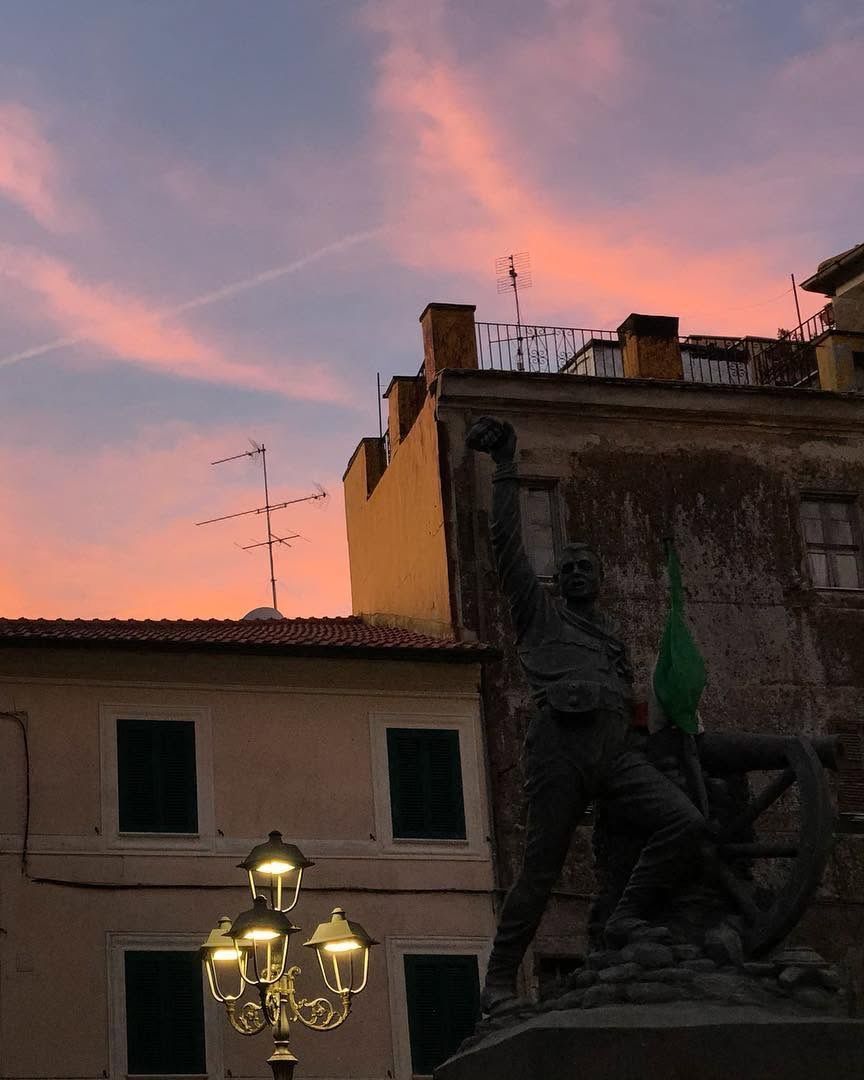
You can cross the centre of Monte Porzio Catone on foot in a few minutes. The Borghese laid it out in the seventeenth century, with an entrance, a main street and a church at the top, like a small theatre.
How is the old town laid out?
The town sits on a hill and the centre follows a trident plan, typical of Baroque town planning, on a small scale as in Genzano and Albano. A main axis climbs from the entrance of the village to the main church and links the two powers of the town, the princes and the Church. The other streets branch off this axis and meet again in the squares.
There are no real walls with gates. A palace does the job of the entrance.
Palazzo Borghese: the gateway to the town
You enter Monte Porzio past the Palazzo Borghese, in piazza Borghese. The Borghese, who held the fief from 1613 for about two centuries, built it with the medieval castle that once closed off the hill in mind: a severe building, with almost no decoration, that works as the symbolic gate of the village. The town council’s guides describe it as a “psychological” wall rather than a defensive one.
The detail to look at is the doorway with the balcony, in sperone stone, with the family’s heraldic symbols below: the dragon and the eagle. The same symbols survive in the town’s coat of arms. The architect is not documented with certainty; some sources link it to Girolamo Rainaldi. According to tradition the princes never really lived in the palace, and for a while it was even used as a granary.
In front of the palace, the square with the fountain known as “Madama” and a double row of holm oaks looks out over the plain, closed on the horizon by the Tiburtini and Prenestini mountains. The bus from the station also stops here.
Along the axis: the market square and piazza Porzio Catone
From the palace you climb the main street.
- The little market square is the first stop, small and enclosed.
- Piazza Porzio Catone is the heart of the town, where the main axis crosses the street running at right angles to it. Here you find the Garibaldino monument, from 1883, which the people of Monte Porzio are fond of, and an inscription recalling the visit of Pope Leo XII in 1827. The square is named after Cato the Censor, and how his name got here is told in why is it called Monte Porzio Catone.
At the top: the main church
The axis ends in piazza del Duomo, where several streets meet. The church of San Gregorio Magno, with its facade between two bell towers, stands where the castle used to be. Its story, from the first church of Gregory XIII to the Borghese rebuilding, is in the article on the church of San Gregorio Magno. The Museo della Città, the town museum, is housed in rooms of the church complex.
Other buildings to look at
Wandering through the side streets you come across buildings that tell you who spent their summers here.
- Palazzo Statuti, where Pope Paul V stayed during his visit to the town.
- Palazzo Ricci-Moscatelli, from the eighteenth century, looking over the plain.
- The English College, of which one part survives with a courtyard on pillars: it was the college’s summer residence. Next to the Palazzo Borghese there was also the Collegio Clementino.
- The Oratory of Sant’Antonio, from 1769, in via Cesare Battisti, home of the confraternity of the same name, with a painting by Gaetano Lapis.
- In via Verdi, a plain building that the Cardinal Duke of York used as a home for poor girls of the town.
How long does it take?
The walk along the main axis, from the Palazzo Borghese to the church and back, takes less than an hour at an easy pace, stops included. The streets go uphill, so wear comfortable shoes. At sunset, from the square in front of the Palazzo Borghese, the plain lights up all the way to Rome.
To arrive by car or train, and for where to leave the car before entering the centre, read how to get to Monte Porzio Catone from Rome.
In short
- Route: Palazzo Borghese, market square, piazza Porzio Catone, piazza del Duomo.
- To see: the doorway with the dragon and the eagle, the Garibaldino (1883), the inscription of Leo XII (1827), the main church, the Oratory of Sant’Antonio (1769).
- Time: about an hour on foot.
- Nearby: Villa Mondragone, Barco Borghese, the history of the town.
Practical info
- Place
- Centro storico di Monte Porzio Catone
- Address
- Piazza Borghese, 00078 Monte Porzio Catone (RM)
- Map
- Open in Google Maps
Sources
- Comune di Monte Porzio Catone, walks in the old town (ProntoCastelli)
- Discover Places, Monte Porzio Catone. Borghese Palace
- Castelli Notizie, Cosa vedere a Monte Porzio Catone (2024)
- Trenitalia, reaching Monte Porzio Catone by train and bus
Written by Osteria Il Tinello, Monte Porzio Catone. Last updated: 5 November 2026. Spotted a mistake? Message us on WhatsApp.