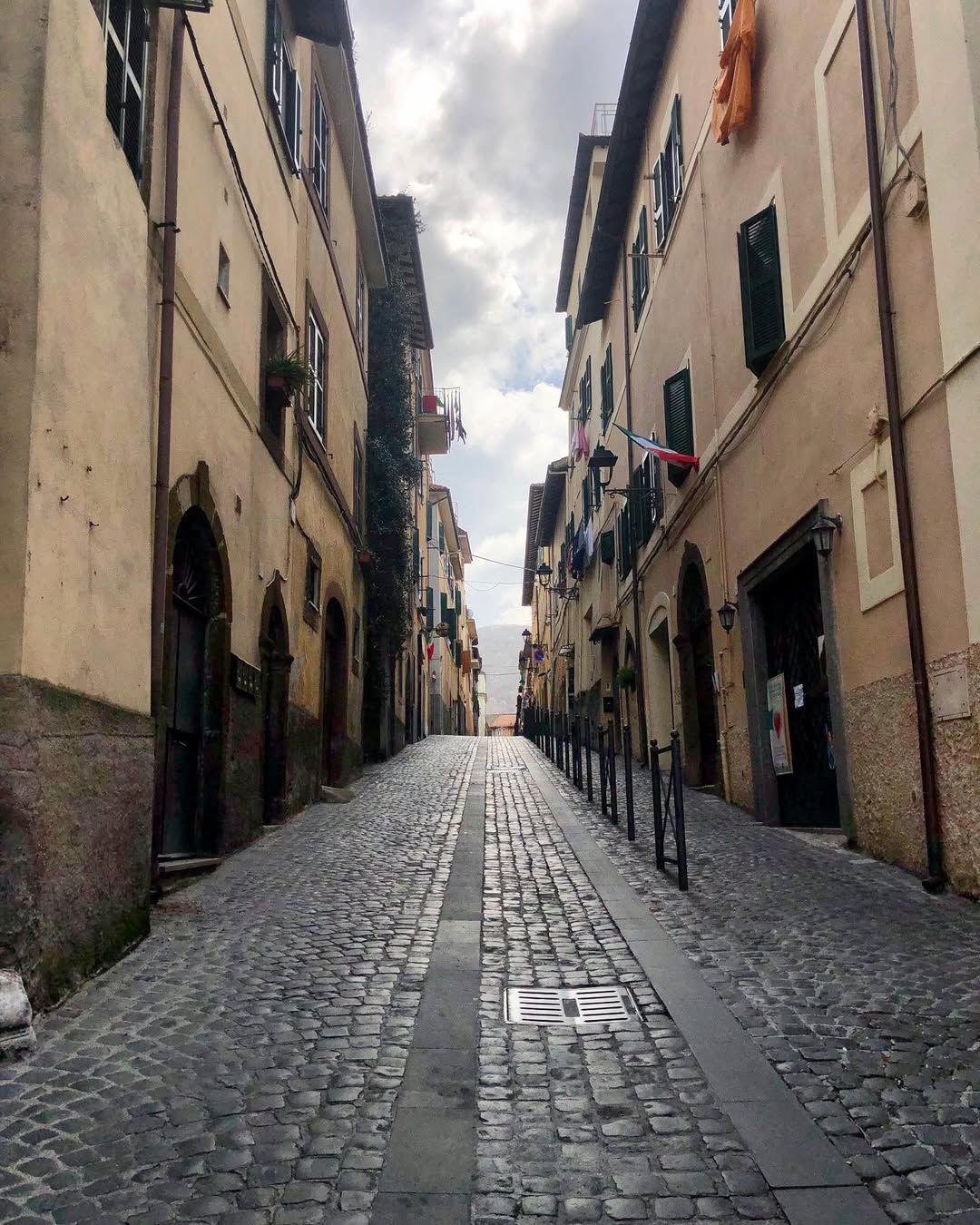
Frascati is the Castelli Romani town everyone has heard of, if only for its wine. It sits at about 320 metres on the Alban Hills, looks down on Rome and borders Monte Porzio Catone. Its story begins next to another city, Tusculum, and for centuries it depended on Rome and the popes.
Before Frascati: the Latins and the Roman villas
People have lived on these hills since very early times, and from the second millennium BC the area belonged to the Latins. The important city was Tusculum, on the hill above present day Frascati, birthplace of Cato the Censor and holiday home of Cicero.
In Roman times the slopes filled with villas. The most famous is the one attributed to Lucullus, the general of the first century BC remembered for his banquets; other finds date from the Flavian emperors.
The name and the medieval village
Frascati appears as a small settlement in documents of the ninth century. The sources do not agree on where the name comes from:
- the most common explanation links it to frasche, the leafy branches used to build huts and shelters;
- tradition says that after Tusculum was destroyed in 1191 the survivors took refuge here in huts roofed with branches;
- another idea points to the gathering of firewood, typical of the area.
The two stories do not fully exclude each other: the village existed before 1191, but it grew after that date.
1191: Frascati takes the place of Tusculum
In 1191 Rome destroyed its old rival Tusculum, in revenge for the battle of Monte Porzio of 1167. The bishop’s seat moved to Frascati, and with the bishop came people, churches and importance. The bell tower of Santa Maria in Vivario, the old cathedral, bears the date 1305.
The papal town
- The first walls were built under Pope Pius II, in the fifteenth century.
- In the early sixteenth century the town passed to the Colonna, then to Lucrezia della Rovere, who in 1522 sold it to Pier Luigi Farnese; from him it went to the Apostolic Camera, that is, to the Papal State.
- In 1527, after the Sack of Rome, the Landsknechts came as far as Frascati but turned back at a wayside shrine of the Virgin. The church of Capocroce was later built there.
- In 1538 Pope Paul III Farnese gave it the rank of city, with the name Tusculum novum, and new walls.
The century of the villas
From the middle of the sixteenth century the hills became the summer retreat of the papal court. In about a hundred years a dozen great villas were built, the Tusculan Villas: in Frascati there are, among others, Villa Aldobrandini, Villa Torlonia, Villa Falconieri and Villa Lancellotti; on the next hill, in Monte Porzio, Villa Mondragone.
Work on the cathedral of San Pietro began in 1599, and its facade was finished at the end of the seventeenth century. In 1616 one of the first free public schools opened, modelled on the one founded by Saint Joseph Calasanz in Rome.
The eighteenth century and Cardinal Stuart
From 1761 the bishop of Frascati was Cardinal Henry Benedict Stuart, Duke of York, the last heir of the exiled Stuart dynasty. He turned the old fortress into a bishop’s palace and gave the cathedral an organ. His story, and that of his brother “Bonnie Prince Charlie”, is in the Frascati curiosities.
In the eighteenth and early nineteenth centuries Frascati was also a stop on the Grand Tour, the journey through Italy of European writers and artists.
The nineteenth century: the train and unification
- In 1837, during an epidemic in Rome, Frascati took in many Romans fleeing the city; according to tradition this is why the town uses Rome’s yellow and red.
- On 5 July 1856 the Rome to Frascati railway opened, the first line built in the Papal State.
- Electric light arrived in 1901, and from 1906 to 1954 a tram linked Frascati to Rome.
8 September 1943
On the day of the armistice, at midday, American bombers struck Frascati, where Field Marshal Kesselring had his German headquarters. About half of the buildings were destroyed and nearly five hundred civilians died. The story of that day is in Frascati, 8 September 1943. The Americans entered the town on 4 June 1944.
From the war to today
Since the 1950s Frascati has become a town of science: it is home to the INFN Frascati National Laboratories, ENEA, the European Space Agency’s ESRIN, and institutes of CNR and INAF. In 2000 the stables of Villa Aldobrandini, restored by Massimiliano Fuksas, became the Museo Tuscolano.
Today Frascati has about 23,000 inhabitants. Its patron saints, Philip and James, are celebrated on 3 May.
Key dates
| Year | What happens |
|---|---|
| 1st century BC | Roman villas on the slopes, including the one attributed to Lucullus |
| 9th century | Frascati appears as a small settlement |
| 1191 | Tusculum destroyed, the bishop moves to Frascati |
| 1527 | The Landsknechts stop at Capocroce |
| 1538 | Paul III makes it a city: Tusculum novum |
| 1598-1602 | Villa Aldobrandini is built |
| 1599 | Work begins on the cathedral of San Pietro |
| 1856 | Rome to Frascati railway, the first in the Papal State |
| 1943 | Air raid of 8 September |
| 1950s | The research laboratories arrive |
Practical info
- Place
- Frascati
- Address
- Piazza San Pietro, 00044 Frascati (RM)
- Map
- Open in Google Maps
Sources
- Wikipedia, Frascati
- Italia.it, Frascati and the Castelli Romani
- Parchi del Lazio, Frascati ai tempi di Nanni (fact sheet)
- Catholic Encyclopedia (1911), Frascati
- Wikipedia, Air raid on Frascati
Written by Osteria Il Tinello, Monte Porzio Catone. Last updated: 9 November 2026. Spotted a mistake? Message us on WhatsApp.